A Hundred Thousand Questions About the Dao 48 / 51
A Walking Staff Carried Emperor Xuanzong to the Moon
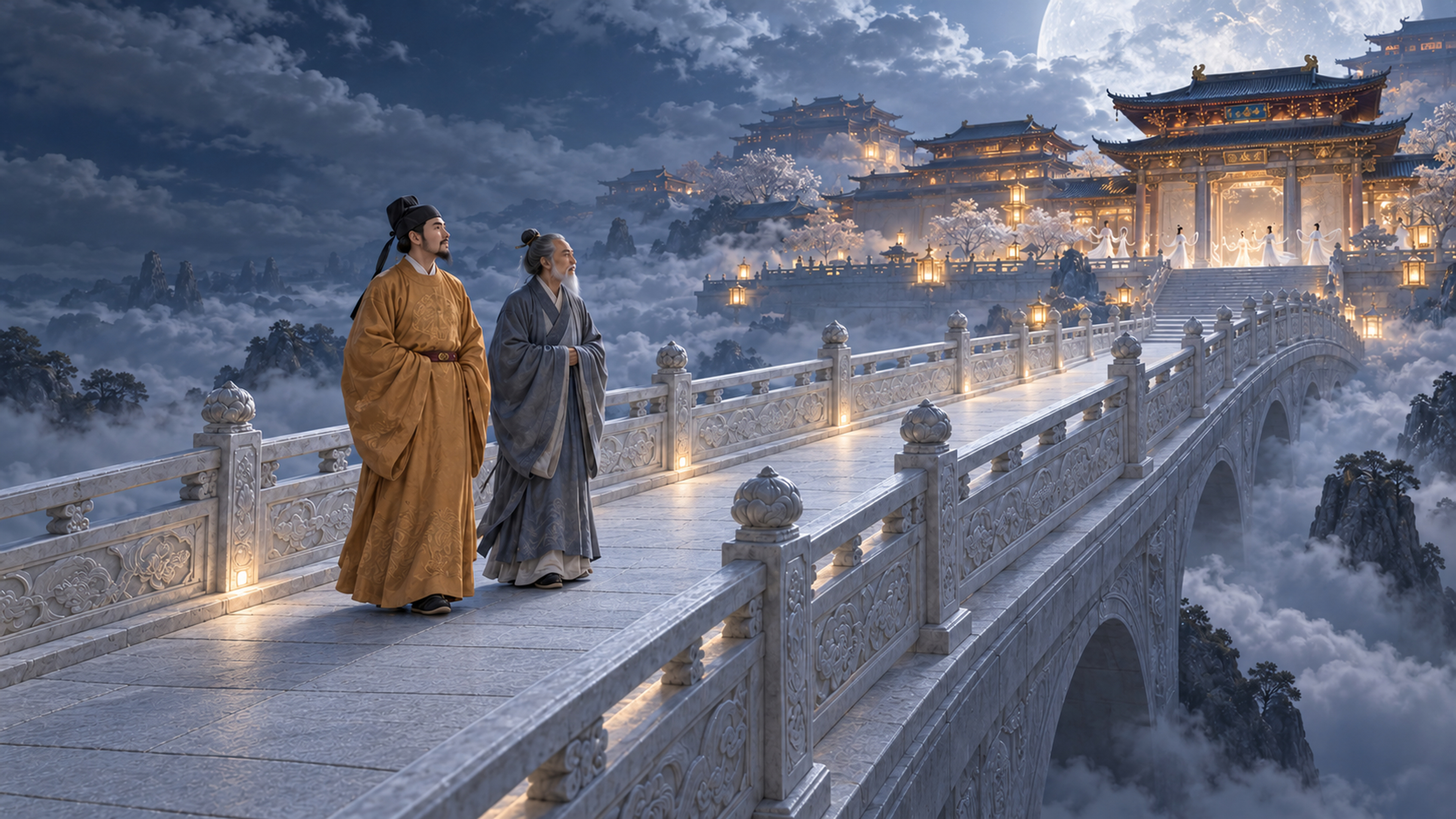
One Mid-Autumn night during the Kaiyuan era, Emperor Xuanzong was admiring the moon in his palace. Luo Gongyuan, standing beside him, suddenly asked, ‘Would Your Majesty like to visit the moon?’ Then he flung his staff into the air. It turned into a silver bridge.
The emperor stepped onto the bridge. The moon was no longer merely a patch of clear light above the courtyard; it had become a place one could reach by following a road.
1. A Daoist from the Palace Led the Way into the Heavens
This wondrous journey appears in “Luo Gongyuan,” chapter 22 of Extensive Records of the Taiping Era. According to the account, Luo Gongyuan was from Ezhou and had loved Daoist arts since childhood. When he first drew the attention of local officials, he was still a little boy.
According to the account, when he was a child, Luo Gongyuan drove away a tall man in white at a spring banquet hosted by the governor of Ezhou, identifying him as the river’s guardian dragon, who had come ashore. The governor asked him to prove it. By the river, Luo dug a pit and channeled water into it, where a white fish five or six cun long swam in. It grew larger and larger; thunder and rain broke out, and a white dragon appeared in midstream. After the governor reported the affair to the emperor, Xuanzong summoned Luo to the palace.
The court adepts Zhang Guo and Ye Fashan, who were also in the palace, initially looked down on the boy. Each held a little over ten game pieces and tested him. He said their hands were empty. When they opened them, all the pieces had appeared in his hands. Only then did they invite him to sit alongside them.
That night, Luo led Xuanzong onto the silver bridge. It blazed with light, and the cold was biting. The two walked dozens of li before a great city gate appeared ahead. Luo told Xuanzong, ‘This is the Moon Palace.’
2. He Memorized the Tune and Returned Along the Bridge
In the Moon Palace’s spacious courtyard, hundreds of immortal maidens in flowing white robes were dancing. Xuanzong asked what piece they were performing. The answer was: “Rainbow Skirt and Feathered Robe.”
Xuanzong “secretly memorized its notes,” committing the melody he heard to memory. He returned along the bridge. Looking back, he saw it disappear section by section as he walked.
Back in the palace, Xuanzong summoned his musicians and composed the Rainbow Skirt and Feathered Robe melody from the tune he had remembered. The bridge vanished, but he brought the music back to the human world.
3. The Human-World Rainbow Skirt Had Another Origin
The Extensive Records of the Taiping Era presents the famous melody as something obtained in heaven, but the surviving records of the music point to another possible source. In his Notes on Biji Mountain, the Song writer Wang Zhuo examined the tune’s origins, citing a Tang history that says Yang Jingshu, military commissioner of Hexi, submitted a melody in twelve bian. Wang concluded that the melody was ‘created in Xiliang and refined by Emperor Ming.’ Here, bian (遍) refers to a section of a musical piece.
Bai Juyi’s Song of the Rainbow Skirt and Feathered Robe also mentions “the Yang family’s creation,” and his note identifies Yang Jingshu.
In a note to his poem “Gate of Jinyang,” the late-Tang writer Zheng Yu names Ye Fashan as the one who led Xuanzong into the Moon Palace, and says the music obtained there matched the piece Yang Jingshu had presented. Different accounts gave the famous melody different guides and connected it to different origins.
Bai Juyi, by contrast, recorded a performance of Rainbow Skirt and Feathered Robe that he had personally witnessed. His account still lets us see how the imagined music of immortals took shape in human sleeves, dance steps, and instruments.
4. Bai Juyi Remembered How It Came to Rest
As a young man, Bai Juyi attended a banquet at court and saw a performance of Rainbow Skirt and Feathered Robe. The dancers wore elaborate ornaments and moved with the music. Chimes, flutes, zithers, and transverse flutes sounded one after another. At first, the opening prelude had no beat, and the dancers had not yet begun.
When the middle section arrived, the music found its beat and the dance began to unfold. The dancers’ light turns swirled like snow; their sleeves rose and fell as if expressing feeling. As the notes thickened and the pace quickened, the music gathered force. Near the finale, other pieces often accelerated toward the end, but Rainbow Skirt and Feathered Robe instead drew out a long note.
Bai Juyi especially loved the prelude before the beat entered. In a poem he wrote, “I love Rainbow Skirt before the beat begins.” He remembered not only the melody’s name, but the order in which the music sounded and the moment the dancers’ robes began to flutter.
After leaving court, Bai Juyi did not hear the piece for eight or nine years. When he took office in Hangzhou, he taught musicians to rehearse it again and saw it performed a few times, then left after a transfer. By the time he reached Suzhou, it was already difficult to find anyone who could dance it.
A friend sent him a long poem about the old dance. As he read, the figures and postures of the past seemed to appear before him again, so he wrote his own memories into a poem.
The silver bridge vanished with each step, while the music could continue only if people remembered it and taught it to others. In the legend, Xuanzong memorized the tune; in the human world, Bai Juyi taught musicians to play it again. Once immortal music reached the human world, its survival depended on people continuing to perform and dance it.